

Table of Contents
A War That Changed India’s Food Story (1965)
In 1965, India and Pakistan fought a full-scale war. During this period, the United States openly supported Pakistan. After the war, the US imposed food and aid restrictions on India.
At that time, India was heavily dependent on American food imports, especially wheat and grains supplied under programs like PL-480. When the supply stopped, India suddenly found itself facing a severe food crisis.
Hunger was no longer a theory—it was a reality.
“Jai Jawan, Jai Kisan”: A Nation Turns to Its Farmers
Faced with this crisis, Prime Minister Lal Bahadur Shastri gave the nation a powerful slogan:
“Jai Jawan, Jai Kisan”
(Hail the soldier, hail the farmer)
The message was clear:
India must feed itself.
This led to the launch of the Green Revolution, starting in the mid-1960s, with Punjab chosen as its heartland due to:
Fertile soil
Assured irrigation
Hard-working farming communities
The goal was noble: produce our own food, end hunger, and never depend on foreign powers again.
The Green Revolution: Success with a Hidden Cost
Initially, the Green Revolution worked wonders. Wheat production skyrocketed. Punjab became the food bowl of India. The nation survived hunger.
But slowly, something went wrong.
To maximize output:
Chemical fertilizers replaced natural manure
Toxic pesticides were sprayed excessively
Soil was forced to produce more, faster, every season
What started as innovation soon turned into overuse and abuse.
Some corrupt traders, suppliers, and officials promoted cheap, unregulated, and highly toxic chemicals. Industrial waste mixed into water sources. Pesticide residues entered food chains.
The land fed the nation—but poisoned its own people.
From Fertile Fields to the Cancer Belt
By the 1990s and early 2000s, doctors in southern Punjab began noticing something terrifying:
Entire villages had multiple cancer patients
Young people, not just the elderly, were falling ill
Cancer became so common it was spoken of casually
Districts like Bathinda, Mansa, Muktsar, and Faridkot slowly earned a dark name:
“The Cancer Belt of India.”
Groundwater tests revealed alarming contamination. Food samples carried pesticide traces. The cost of treatment crushed families.
The Birth of the Cancer Train
Local hospitals could not cope. Treatment was expensive. Poor farmers had no choice.
That’s when the Cancer Train quietly became part of everyday life.
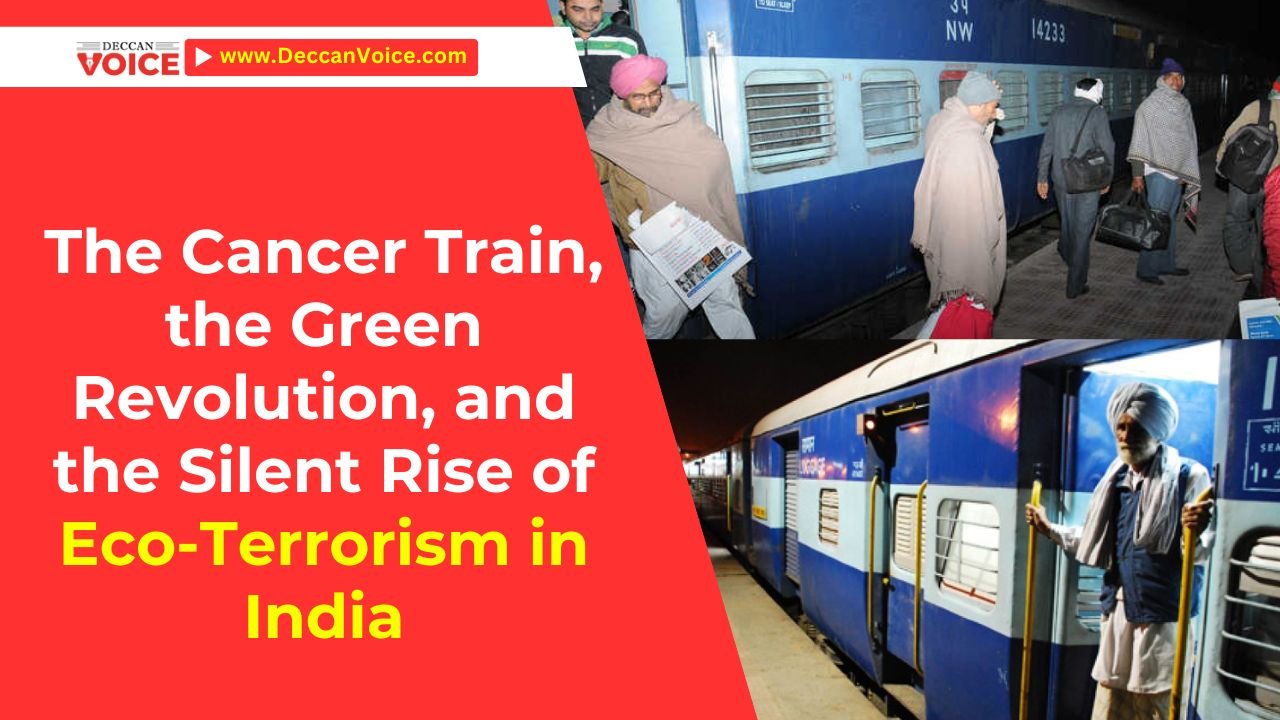
Every night, a train leaves Bathinda for Bikaner, carrying hundreds of cancer patients and caregivers. No banners. No speeches. Just silent hope.
People began calling it what it truly was:
The Cancer Train.
Not because of symbolism—but because of reality.
A Silent Mass Killer
Today, nearly 7 lakh people die of cancer every year in India.
In the last two decades, cancer has killed more people globally than terrorism. Yet:
There are no emergency summits
No global outrage
No breaking-news countdowns
Why?
Because this killer is slow. Invisible. Systemic.
Cancer: The New Face of Terrorism
If terrorism destroys lives, families, and futures, then what do we call:
Poisoned water
Toxic food
Policy-driven environmental collapse
This is eco-terrorism.
It doesn’t explode.
It accumulates.
And the most uncomfortable truth?
This eco-terrorism has:
No religious identity to blame
No convenient enemy
No “other” to demonize
Muslims are not involved.
So there is silence.
Conclusion: From Self-Reliance to Self-Destruction
The Cancer Train exists because:
India was forced into self-reliance
Farmers answered the nation’s call
Systems failed to protect land and life
What began as a patriotic movement slowly became a public health disaster.
The Cancer Train is not just about Punjab.
It is about how development without ethics becomes destruction.
And until we call this what it is—
eco-terrorism—
the train will keep running.
Think about it.