

Table of Contents
Introduction: When Royal Vision Met Public Need
Long before modern cities depended on buses and metros, Hyderabad witnessed a revolutionary idea that changed how people moved. In 1932, under the leadership of the Seventh Nizam of Hyderabad, Mir Osman Ali Khan, the city introduced its first organized public bus service — famously remembered as the “Deccan Queen.” What began as a royal initiative to ease public hardship later became the foundation of one of the largest road transport systems in the world.
The Birth of Public Transport in Hyderabad (1932)
The formal beginning of public road transport in Hyderabad dates back to April 18, 1932, when the Nizam State Rail-Road Transport Department (NSR-RTD) was officially commissioned.
This historic initiative was launched with the support of Muhammed Akbar Hydari, the then Prime Minister of Hyderabad State. The goal was simple yet visionary: to provide affordable and reliable transportation for ordinary citizens in a growing city.
The First Fleet: A Journey from Scotland to the Deccan
To start this ambitious project, 27 Albion buses were imported from Glasgow, Scotland.
The buses arrived by ship at Bombay (now Mumbai)
From there, they were driven by road to Hyderabad, a journey that took 27 days
This itself was a remarkable logistical achievement for the era
The buses were initially stationed at three major depots:
Kachiguda
Narketpally
Kazipet
The First Route: The Original ‘Deccan Queen’
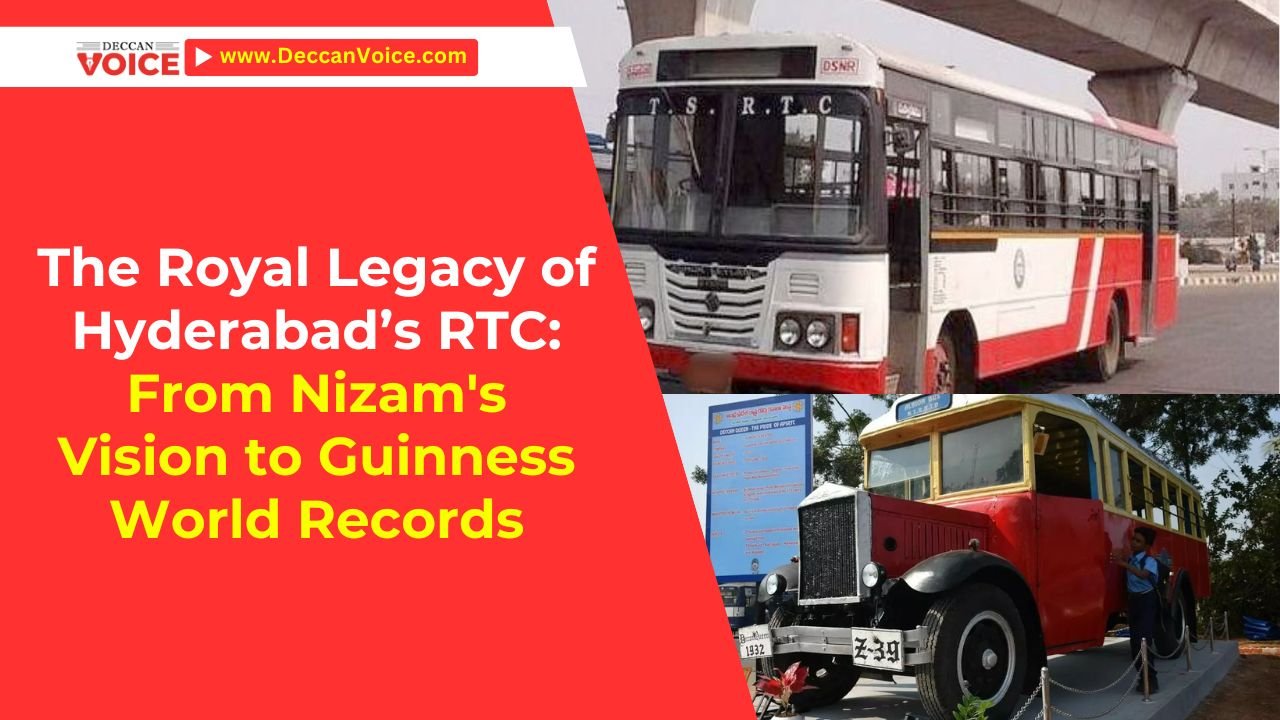
The very first bus route ran between Charminar and Raniganj, connecting the heart of the old city to key commercial areas. This bus soon earned the affectionate nickname “Deccan Queen,” symbolizing pride, progress, and public service.
Technical Features of the Heritage Bus
For its time, the Deccan Queen was a modern engineering marvel:
Seating Capacity: 19 seats (including driver and conductor)
Color: Bright red — leading to the popular local name “Yerra Bussu” (Red Bus)
Design:
Single-door entry
Step-up boarding
Vintage-style windows
Tires:
Front: 7.00×20
Rear: 9.00×20
Even today, transport historians study its design as an early example of functional public vehicle planning.
A Royal Gift: Zahra Begum and the ‘Z’ Legacy
The inspiration behind the transport system came from Zahra Begum, the Nizam’s mother.
Moved by the sight of people walking long distances in extreme heat — especially between Nampally and Narketpally — she personally invested 3.71 lakh Hyderabad Rupees to launch the bus service.
The ‘Z’ Symbol
In her honor, the letter ‘Z’ was permanently assigned to the registration numbers of RTC buses
This special arrangement continues even today under agreements with the Indian government
The ‘Z’ stands as a living reminder of royal compassion and civic responsibility
Preserving the Deccan Queen: A Living Heritage
Out of the original 27 buses, only two Deccan Queen buses survive today:
One in Hyderabad
One in Vijayawada
Vijayawada’s Historic Display
The bus was moved to Pandit Nehru Bus Station (PNBS) in 1990
In January 2023, it was renovated and unveiled for public viewing
Two retired RTC drivers inaugurated the display, adding emotional value to the event
A dedicated selfie spot was created so travelers could interact with this 90-year-old symbol of history
From Nizam’s Vision to a Global Record
What started as a compassionate royal initiative later evolved into today’s RTC network, which has earned Guinness World Records for its size and operations. The roots of this massive system lie firmly in the humble yet visionary Deccan Queen.
Conclusion: More Than a Bus, a Legacy
The Deccan Queen was not just a vehicle — it was a statement. It reflected a time when governance prioritized public welfare, foresight, and dignity. As modern cities rush toward futuristic mobility, Hyderabad’s first bus reminds us that true progress begins with empathy and vision.
Preserving this legacy is not just about honoring the past — it’s about learning how inclusive development can shape the future.