

Table of Contents
A controversial incident in Faridabad, Haryana, has triggered a debate over anti-national slogans, communal propaganda and the role of social media in shaping public opinion.
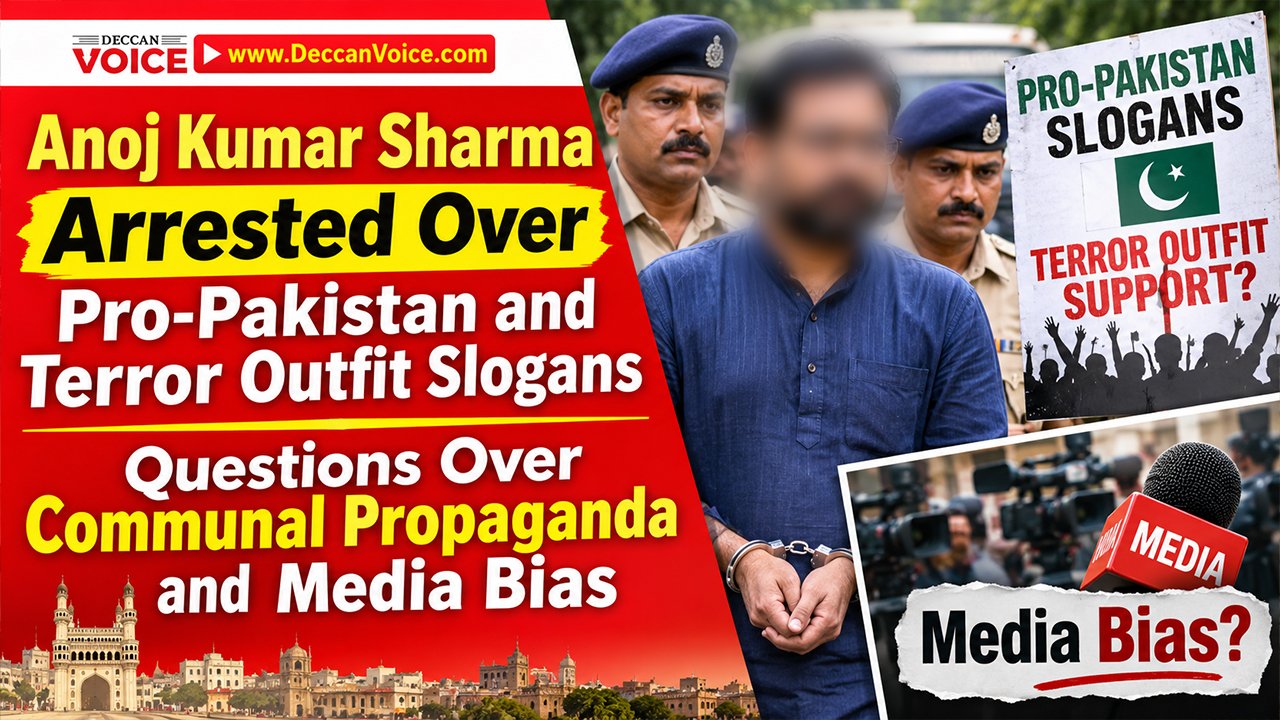
A man identified as Anoj Kumar Sharma, also reported as Anoj Kumar, was arrested after a video allegedly showing him raising slogans in support of Pakistan, the ISI, Al-Qaeda and designated terrorist Hafiz Saeed went viral.
However, the controversy took another turn when claims began circulating that Anoj Kumar had converted to Islam and adopted the name ‘Sunni Khan’. Some reports repeated allegations made by neighbours about his religious practices and visits to madrasas.
But there is an important detail: Faridabad Police reportedly clarified that they had no information confirming his alleged religious conversion.
This raises an important question: why was an unverified religious identity introduced into a case that was already being investigated on the basis of alleged slogans? And should people or organisations that deliberately spread false communal narratives also face legal scrutiny?
1. Who Is Anoj Kumar Sharma?
According to media reports, the arrested man is identified as Anoj Kumar Sharma, although several reports use the shorter name Anoj Kumar.
He is reportedly a native of Himachal Pradesh and has been living in Faridabad for several years. Reports describe him as an auto-rickshaw driver with a postgraduate degree.
He reportedly lives in Sector 3 of Ballabhgarh with his father, a retired government employee, and his sister.
Some reports give his age as 47, while others mention different figures. These biographical details have been attributed to media reports and local accounts.
The central issue, however, is not his personal background or religion. It is the alleged conduct captured in the viral video and the evidence that emerges from the police investigation.
2. What Happened in Ballabhgarh?
The incident reportedly occurred around 12:50 pm on November 22, 2026, outside a senior citizens’ club in Sector 3, Ballabhgarh.
According to the complaint filed by Charan Singh, general secretary of the club, he and some associates were involved in work related to a water pipeline when Anoj Kumar arrived and began arguing with them.
The disagreement reportedly escalated after Anoj objected to the pipeline repair work being carried out outside his residence.
During the confrontation, he allegedly raised slogans supporting Pakistan and terrorist organisations.
A person present at the scene recorded the incident on a mobile phone. The footage subsequently circulated widely on social media.
3. What Slogans Were Allegedly Raised?
According to media reports describing the video, the accused was heard raising slogans including:
- Pakistan Zindabad
- ISI Zindabad
- Hindustan Murdabad
- Al-Qaeda Zindabad
- Hafiz Saeed Zindabad
The video reportedly shows him challenging people present at the location to record him and claiming that nobody could take action against him.
If the footage and allegations are established through investigation, the incident deserves serious legal scrutiny. Supporting terrorist organisations or making statements that promote hostility and threaten communal harmony cannot be dismissed as an ordinary disagreement.
At the same time, the investigation must establish the full circumstances and the applicable legal provisions.
4. How Did the ‘Sunni Khan’ Story Enter the Controversy?
After the video went viral, another narrative began circulating: that Anoj Kumar had allegedly converted to Islam and adopted the name Sunni Khan.
According to PTI-based reports, some neighbours claimed that he offered Namaz at home, visited madrasas and religious gatherings, and had changed his religion.
These claims were repeated in several news reports and social media posts.
However, Faridabad Police spokesperson Yashpal reportedly stated that the police had no information confirming the alleged religious conversion.
This is a significant distinction.
There is no publicly established evidence in the reports reviewed confirming that Anoj Kumar legally or officially changed his name to Sunni Khan or converted to Islam.
The name should therefore not be presented as his confirmed identity.
A person’s religious practices, personal beliefs or visits to religious institutions cannot be treated as evidence of terrorist connections or criminal activity.
5. Did the Conversion Claim Become a Tool for Communal Propaganda?
This is where the incident deserves closer public scrutiny.
The viral video showed a man identified as Anoj Kumar allegedly raising slogans supporting Pakistan and terrorist organisations. Instead of limiting the discussion to the alleged conduct and the police investigation, an additional story about his supposed conversion to Islam began circulating.
Some social media accounts and local claims portrayed him as a Muslim convert and used the alleged identity ‘Sunni Khan’ to connect the incident with a wider narrative about Muslims and extremism.
The conversion claim was subsequently repeated by news outlets, even though the police had not confirmed it.
This raises a serious question: why was an unverified religious identity given so much importance in a case where the accused’s alleged actions were already the subject of an FIR?
Criticism of extremist statements should be based on evidence. It should not become an opportunity to portray an entire religious community as responsible for the conduct of one individual.
If individuals or organisations knowingly circulated an unverified identity claim to create communal hostility, their role also deserves investigation.
The police should examine the original sources of the conversion allegation, identify whether any deliberate misinformation was circulated, and determine whether anyone attempted to provoke hostility between communities.
However, responsibility should be established through evidence. No organisation or individual should be declared guilty merely because of their religious or political affiliation.
6. What Did Police Find During the House Search?
Following the arrest, police searched the accused’s residence.
According to PTI-based reports, investigators did not recover any suspicious item apart from a world map.
The discovery of a world map does not, by itself, establish any connection with Pakistan, a terrorist organisation or a foreign intelligence agency.
The Times of India also reported that the initial police inquiry had not revealed suspicious activity linked to the accused.
These findings do not settle the case. They do, however, make it important to distinguish the allegations arising from the video from claims about a larger terror connection.
The police must investigate the available evidence rather than allow speculation to replace facts.
7. Was He Connected to Pakistan or Terrorist Organisations?
The slogans allegedly heard in the video refer to Pakistan, the ISI, Al-Qaeda and Hafiz Saeed.
But the available reports do not establish that Anoj Kumar was a member of any terrorist organisation, had operational links with Pakistan, or was involved in a terror conspiracy.
Police reportedly said their initial investigation had not revealed suspicious activity linked to him.
Therefore, describing him as a confirmed Pakistani agent or terrorist would be premature.
If investigators uncover evidence of terrorist links, appropriate action should follow. If no such evidence emerges, the public should not be encouraged to believe otherwise.
8. What Legal Action Has Been Taken?
Police registered a case under Section 196(1) of the Bharatiya Nyaya Sanhita (BNS), which deals with promoting enmity between different groups on grounds including religion, race, place of birth, residence and language, and acts prejudicial to the maintenance of harmony.
Anoj Kumar was arrested on the night of November 22 and produced before a court on November 23. Reports state that he was sent to judicial custody.
The investigation remains ongoing.
An arrest and judicial custody are not the same as a conviction. The allegations must be established through the legal process.
9. A Question for Prime-Time Television: Would the Coverage Be Different If the Accused Were Muslim?
This case also raises questions about selective outrage in sections of Indian television media.
Consider a hypothetical situation: if the person in the same video had been identified as a Muslim, would some prime-time television channels have immediately turned the incident into a national debate about radicalisation, madrasas, religious conversion and alleged terror networks?
Would some anchors have demanded the invocation of the Unlawful Activities (Prevention) Act (UAPA) before the investigation had established the facts?
This is a question about consistency in media coverage, not a claim that every television channel behaves in the same way.
The expression ‘Godi media’ is frequently used by critics to describe news outlets they believe are politically aligned with those in power. Whether that criticism is justified in a particular case should be assessed through actual reporting and editorial conduct.
In the present case, the reported legal action is under BNS Section 196(1). The available reports do not indicate that UAPA has been invoked.
The principle should be simple: the same standards must apply regardless of whether an accused person is Hindu, Muslim, Christian or belongs to any other community.
If a person raises slogans supporting terrorist organisations, the police must investigate. If someone spreads fabricated communal allegations, that conduct must also be investigated.
National security must not become a political or religious weapon, and the law must not be applied selectively.
10. Our Appeal to Faridabad Police: Investigate Both the Original Incident and the Communal Misinformation
We urge Faridabad Police to conduct a fair and comprehensive investigation into every aspect of this incident.
First, the allegations against Anoj Kumar Sharma must be investigated thoroughly. If the video is authentic and the allegations are established, appropriate legal action should follow under the relevant provisions of law.
Second, investigators should examine how the ‘Sunni Khan’ conversion story originated and who circulated it as fact despite the absence of police confirmation.
If any individuals, social media accounts or organisations deliberately fabricated or promoted false claims to blame Muslims collectively, provoke communal hostility or spread hatred, the police should investigate their conduct and register appropriate cases wherever the evidence and law justify doing so.
This request applies to everyone, irrespective of whether they belong to a Hindu organisation, a Muslim organisation, a political party or any other group.
We are not asking for action against any organisation merely because of its identity or ideology. We are asking for accountability where there is evidence of deliberate misinformation, incitement or unlawful promotion of hatred.
The law should apply equally to the person allegedly raising anti-India slogans and to anyone deliberately exploiting the incident to spread communal hatred.
Conclusion: Justice Must Be Based on Evidence, Not Religious Identity
The Faridabad incident has two separate issues that deserve attention.
One is the alleged conduct of Anoj Kumar Sharma, who was arrested after a video reportedly showed him raising slogans supporting Pakistan and terrorist organisations.
The other is the unverified claim that he had converted to Islam and adopted the name Sunni Khan, a story that was repeated in public discussion despite the police reportedly saying they had no information confirming it.
Both matters deserve proper investigation.
If the accused committed an offence, he must face the legal consequences. If anyone deliberately used this incident to spread false information, blame Muslims collectively or promote hatred between communities, that conduct must also be examined under the law.
India’s security, communal harmony and constitutional values cannot be protected through selective outrage or fabricated narratives.
The same law, the same accountability and the same standards of evidence must apply to everyone.